Residents Refuse to Pay Common Area Fees? What Can the Juristic Person Do Before Filing a Lawsuit?
Residents Refuse to Pay Common Area Fees? What Can the Juristic Person Do Before Filing a Lawsuit?
The truth is that non-payment of common area fees can indeed lead to legal action under the law, but filing a lawsuit right away isn't always the best solution. This article looks at what tools a juristic person has at its disposal before reaching that point, and what the correct steps should be.
What Happens When Residents Don't Pay Common Area Fees
Common area fees are the funds used to maintain the shared spaces and utilities of a project, whether that's the swimming pool, elevators, security systems, or common garden areas. When multiple residents fail to pay their common area fees over time, the result isn't just a growing debt figure — it directly affects the quality of life of every resident in the project.
In a housing estate, unpaid common area fees directly impact the budget for road maintenance, street lighting, and security systems. In a condominium, overdue common area fees can delay elevator or fire suppression system maintenance, which has a direct impact on safety. It also undermines fairness within the community, since residents who pay on time end up shouldering the burden for those who don't.
If Residents in a Housing Estate Don't Pay Common Area Fees, What Can the Juristic Person Do
Before resorting to legal action, there are steps a juristic person should take in order. Beyond being procedurally correct, these steps also make it more likely that payment can actually be collected without always having to rely on the courts.
Always Send a Notice First
The first step is to send a formal notice. In some cases, residents who haven't paid may simply have forgotten or never received the invoice. Sending a notice at least twice — by registered mail and through a digital channel — reduces the chance that a resident can claim they "never received notice." Well-documented notices are also valuable later if the matter escalates to a lawsuit for common area fees, as they show that the juristic person followed proper procedure.
Charge Late Fees According to the Regulations
Charging late fees for unpaid common area fees, whether in a housing estate or a condominium, is a right the juristic person holds under the law. The rate differs by project type. For housing estates, the law caps the late fee at no more than 10% per year of the outstanding amount. For condominiums, under Section 18/1 of the Condominium Act, the cap is no more than 12% per year for arrears of up to 6 months, and no more than 20% per year for arrears exceeding 6 months. It's important to charge late fees strictly in line with the applicable regulations, since charging more than what is permitted could weaken the case later on.
Keep Complete Records
This step is critical but often overlooked. Good recordkeeping means having documentation of how much is owed, since when, the dates notices were sent, and whether there was any response. Juristic persons using an online management application have all of this information consolidated in one place, ready to be used as case evidence immediately if needed.
Filing a Property Lien with the Land Department Before Taking Legal Action
Once all evidence has been gathered, for housing estates there is another important step the juristic person should consider taking in parallel: filing for a property lien with the Land Department. This prevents the property owner from transferring ownership, selling, or mortgaging the property while legal proceedings are being prepared. It serves as a proactive risk-prevention measure that helps protect the juristic person's right to claim the debt. If the transfer of ownership is allowed to happen first, pursuing the debt or enforcing judgment later becomes much more difficult.
The documents required for filing with the Land Office in the area where the property is located include:
- A record of outstanding common area fees
- Notice letters and demand letters
- Evidence of communication with the resident
- Meeting resolutions (if any)
When Should a Lawsuit Be Filed for Common Area Fees
The decision on when to file a lawsuit for common area fees depends on several factors. Generally, if the juristic person has sent repeated demand notices and the resident still hasn't responded or refuses to pay without justification, or if the accumulated arrears are affecting the project's operating budget, these are clear signals that the juristic person is in a position to file suit for common area fees.
Signs that it's time to begin legal proceedings:
- The resident has been in arrears for more than 6 months with no response
- There has been communication, but the resident refuses to pay without justification
- The outstanding balance, including late fees, has grown large enough to affect project management
For condominiums, if a lawsuit for common area fees is filed, the court will consider whether the juristic person followed the correct procedures. Having complete documentation and understanding the proper process from the start will make the case significantly stronger.
Filing a Lawsuit for Common Area Fees in a Housing Estate
 For projects governed by the Land Allocation Act, filing a lawsuit to recover common area fees in a housing estate is a right the juristic person can exercise under the law, provided a resolution from the committee or general meeting supports the filing. This type of case is classified as a consumer case and must be filed with the court in the defendant's domicile. The advantage is that no court fees need to be paid upfront, meaning the housing estate can file suit to recover common area fees without bearing high upfront costs. For juristic persons who want experts to handle the entire process on their behalf, there is also a debt collection and legal action service for outstanding common area fees available to support this.
- Gather all evidence of outstanding balances and notice letters
- Prepare a summary of the debt along with late fees per the regulations
- Send a final demand letter before filing suit
- File the complaint with the court that has jurisdiction over the defendant's domicile
Statute of Limitations for Filing Suit to Recover Common Area Fees
 A question many juristic persons ask is how many years the statute of limitations allows for filing suit to recover common area fees. Under Section 193/33(4) of the Civil and Commercial Code, the statute of limitations for claiming common area fees — for both housing estates and condominiums — is 5 years, counted back from the date the lawsuit is filed. This means any debt older than 5 years before the filing date is time-barred and can no longer be recovered.
It's important not to let arrears sit for too long, approaching the limitation period, because the longer it takes, the harder it becomes to gather evidence, and the resident may raise the statute of limitations as a defense.
Common Scenarios
The following example scenarios illustrate how to handle residents who don't pay common area fees, and the outcomes when different projects handle the issue differently:
Condominium case in Bangkok: A resident had been in arrears on condominium common area fees for over 18 months. The juristic person sent repeated demand letters but received no response. Ultimately, the juristic person filed suit to recover the condominium common area fees and won the case, because it had complete evidence, including notice letters, communication records, and clear monthly debt summaries.
Suburban housing estate case: Several residents who were behind on common area fees were sued at the same time, after the juristic person had let the problem of unpaid common area fees accumulate over several years. This case shows that being sued together with multiple defendants at once drives up litigation costs and makes the process more complex than if the issue had been addressed from the start.
Sample Complaint for Recovering Common Area Fees
A typical complaint for recovering common area fees generally includes the following key elements:
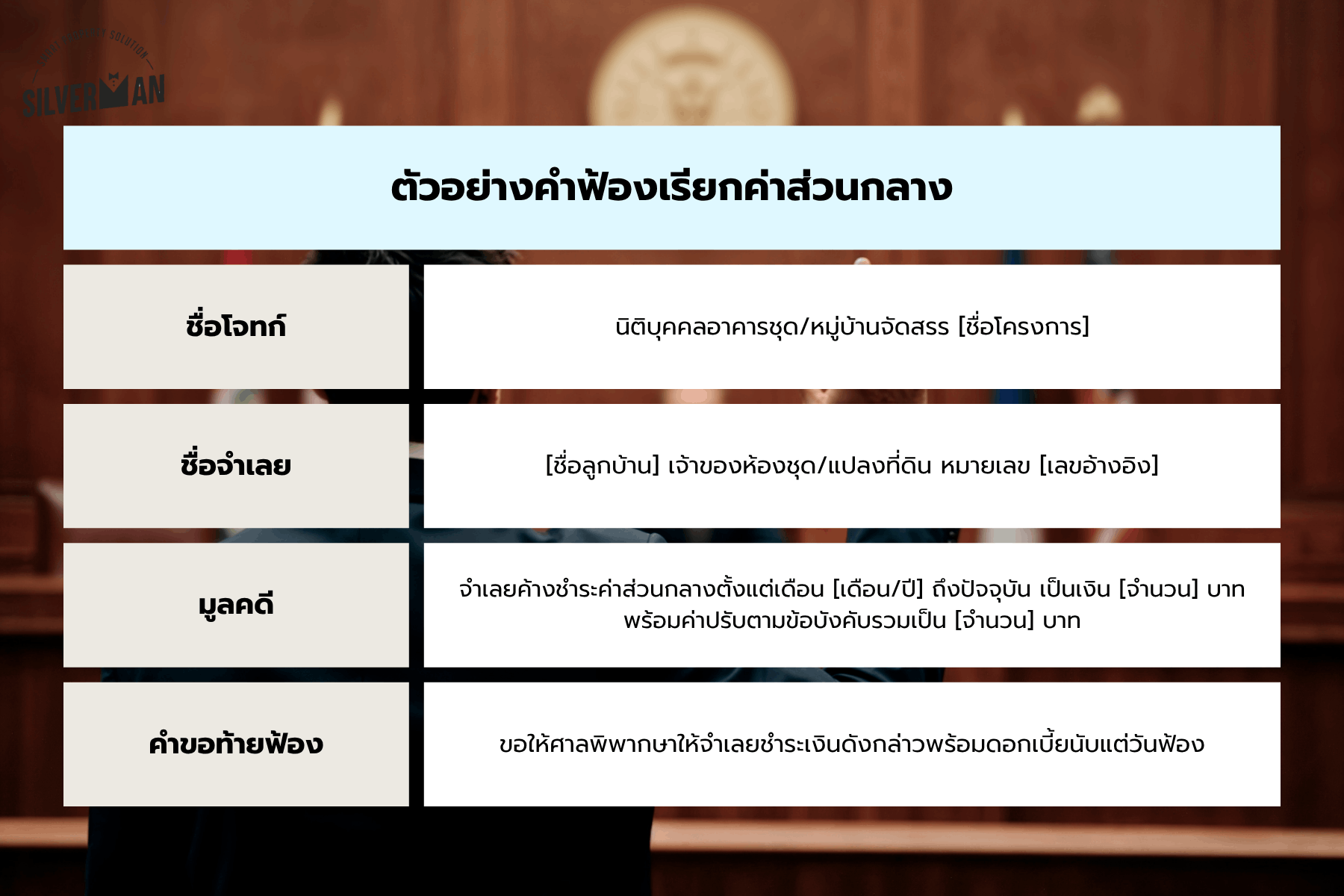 The documents needed to prepare an initial complaint include:
- Certificate of juristic person registration
- Registration record of appointment / change of directors or the juristic person's manager
- House registration / national ID card of the property owner
- The juristic person's regulations
- Condominium unit ownership certificate (Or. Chor. 2)
- Demand letter for payment, along with the EMS delivery confirmation slip
- Summary of the outstanding debt
Unpaid common area fees, whether in a housing estate or a condominium, aren't something that needs to be rushed straight to litigation — but they also shouldn't be left unaddressed. The key is having a solid system in place from the start: timely notices, complete records, and knowing when it's time to move to the next step. Silverman.app helps juristic persons manage all of this in one place — from an automated debt tracking system that sends notices and keeps records every step of the way, to late fee calculations based on the regulations, to arrears reports ready to be used as case evidence at any time. When every step is systemized, the path from a payment reminder to actually collecting the money is much shorter than you'd think. Call 08-1442-6888, 06-5579-6844, or contact us via Line Official.


Download Application


Contact us for more information


Add-On services
- E-meeting (e-AGM)
- Visitor Control Management and Parking lot control
- Security Systems and License Plate Recognition (LPR)
- AI Facial Recognition & Access Control Management System
- Automatic Debt Collection System and Legal Services
- Incorporation services and project assignments
- Accounting As A Service
- Audit As A Service
Connect with us
- Management & Accounting program
- E-meeting (e-AGM) and E-vote
-



Member of


Certified by


Awarded by

Accounting and Finance
Juristic Person Management
Property Management Services
Accounting Software for Juristic
Management Software for Juristic
Read More