It is still possible to report the incident. Gather whatever evidence remains, such as photos taken before cleaning, receipts, a property list, repair quotations, and accounts from people who were present, and submit these for the insurer to consider.
How to Claim Flood Insurance for Homes and Condos: Documents and Steps for Juristic Persons
2 October 2026
Written by:SILVERMAN
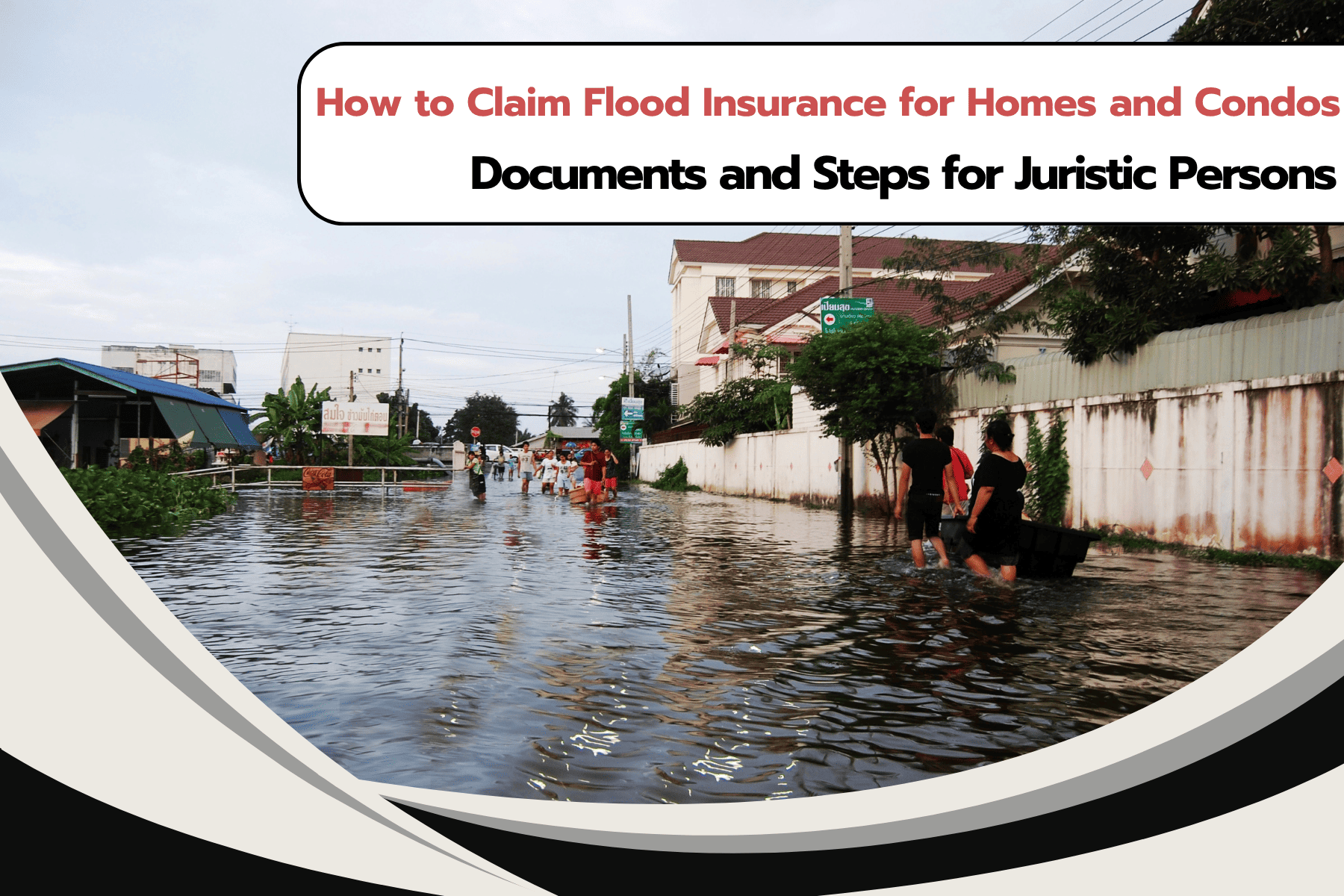
Flooding can cause damage to homes, condominium units, building systems, and shared common areas very quickly, particularly during periods of sustained heavy rain. In late September 2026, the Department of Disaster Prevention and Mitigation reported flooding across 25 provinces affecting more than 174,000 households. When that happens, the questions that follow are immediate: what does the flood insurance policy actually cover, when does the claim need to be filed, and how should evidence be collected?
For condominiums and housing estates, there is an additional layer of complexity. Damage needs to be separated into what belongs to individual unit owners and what falls under the juristic person's responsibility for common property. The most important thing is to prioritise safety first, then notify the insurer, document the damage, and preserve records at every step. Do not wait for the water to fully recede or for all documents to be gathered before making an initial report.
This article provides general information about flood insurance claims. Actual conditions and required documents vary by policy. Policyholders should check their policy schedule, endorsements, and guidance from their insurer directly.
What Does Flood Insurance Cover

Having a home insurance or fire insurance policy does not automatically mean that all flood damage is covered. It is necessary to check whether the policy explicitly includes flood coverage or whether there is an endorsement that extends protection to include it.
Flood insurance coverage may apply to structures such as the building itself, fences, walls, garages, and extensions, as well as contents such as furniture and electrical appliances. Not every policy covers both categories. Some cover only the structure, while others include contents up to a specified limit.
Before determining whether damage is claimable, five things should be checked:
- The insured property
- The coverage limit
- The excess or deductible
- Policy exclusions
- The date coverage takes effect
The Office of Insurance Commission (OIC) notes that residential insurance plans vary in scope, so what matters is the actual policy held, not the product name alone.
When Flooding Affects a Home, Condo, or Housing Estate, Who Files the Claim
The person who files the claim should be the policyholder or someone with authority under the policy. This cannot be decided purely by where the damage occurred. Property should first be separated into two categories. For common property, the authority of the person acting and the duties of the juristic person committee under the project's regulations should also be checked.
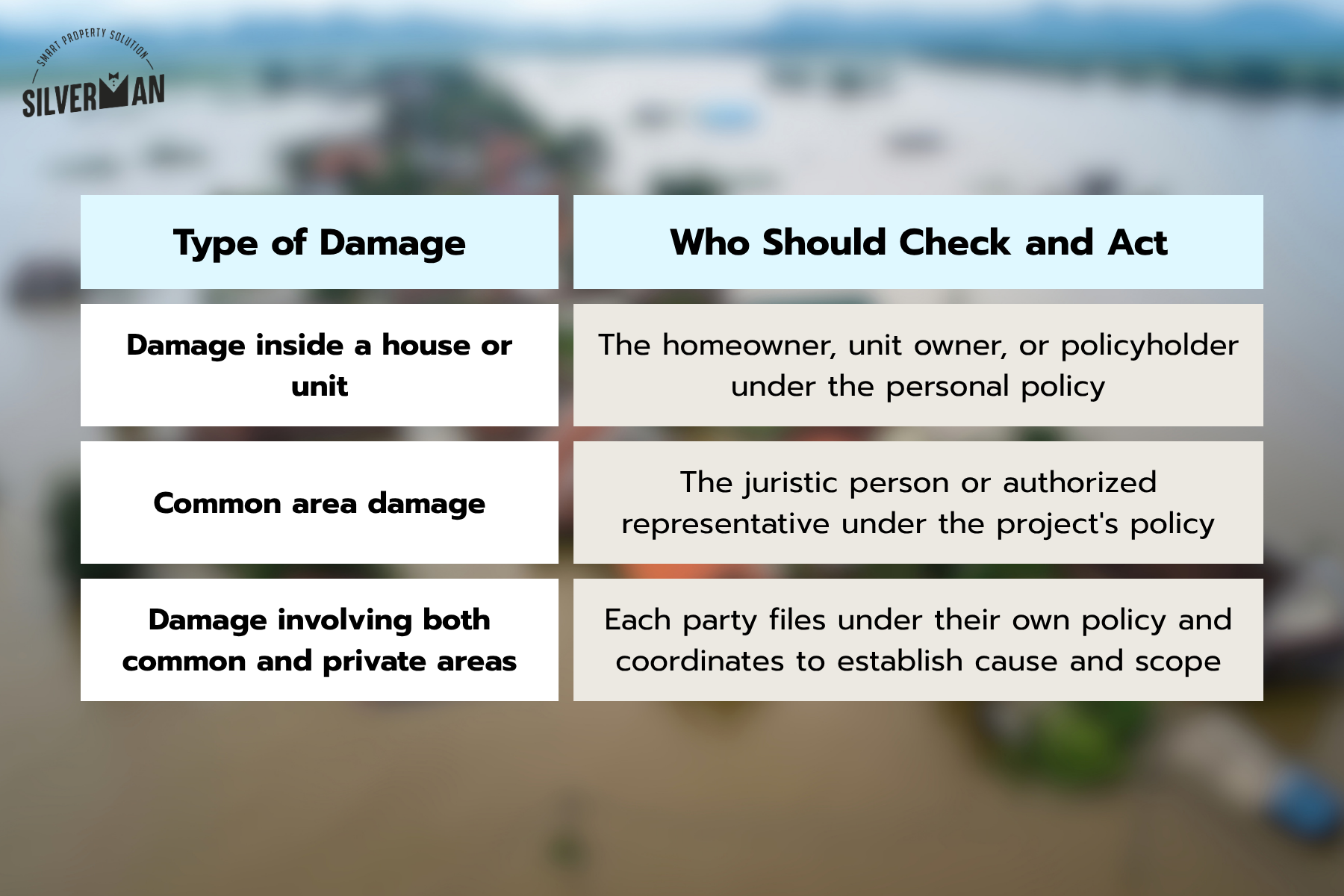
For condominiums, common property may include electrical systems, lifts, water pumps, the juristic person office, car parks, gates, and security equipment. Being classified as common property does not mean every item is automatically covered. It must be confirmed that the item is included in the insured list and within the coverage amount of the project's policy.
For damage inside a unit or house, the owner should check their own policy to confirm whether it covers the structure, fit-out, furniture, and appliances. If the cause involves shared systems or cannot yet be clearly determined, neither party should rush to assign responsibility. The insurer and relevant experts should be allowed to investigate the facts first.
What to Do Before, During, and After a Flood
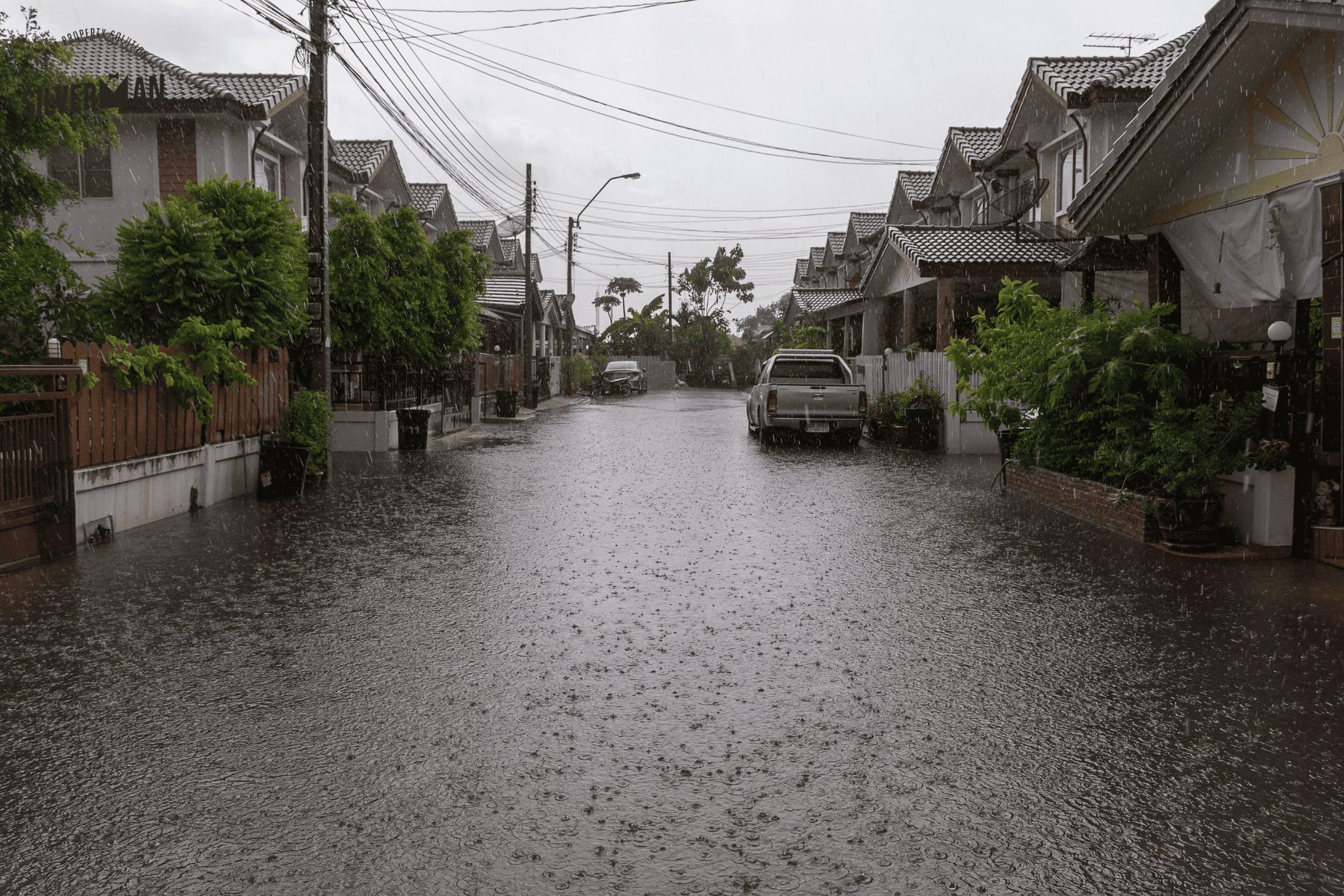
When a Warning Is Issued or the Area Begins to Show Risk
When a warning is issued regarding heavy rain, flash floods, overflowing rivers, or storm surge from relevant authorities, juristic persons should assess the project's risk based on location, surrounding water levels, and drainage routes. Do not wait until water has entered the building to act.
- Check whether the policy is still active and covers flood damage, prepare the policy number and claim reporting channel, and photograph the condition of the property before any damage occurs
- Check water pumps, drainage, backup power, and flood barriers, and move documents, electrical equipment, and movable assets out of at-risk areas when it is safe to do so
- Notify residents of areas to watch, car park and route impacts, and emergency contacts, and designate a coordinator for theinsurer, broker, and building systems contractors
During the Flood
The safety of residents and staff must come before evidence collection. If there is risk from electrical hazards, strong water currents, or structural damage, do not enter to photograph or move property without qualified professionals present.
When it is safe to do so, record the date, time, location, water level, and nature of the damage using photos or video. Report the incident to the insurer or broker and keep the reference number and details of the person who received the report.
After the Water Recedes
Do not rush to discard or repair everything before recording evidence. Photograph damage from multiple angles, including watermarks, machinery serial numbers, and installation positions, then prepare a list of affected property.
If cleaning, moving, or emergency repairs are necessary for safety reasons, photograph before and after, keep receipts, and notify the insurer. When beginning restoration of common areas, juristic persons may find it useful to use a maintenance management system to track who is responsible for each task, current status, and evidence of completed repairs.
What Documents Are Needed to Claim Flood Insurance
The documents required depend on the insurer, policy type, policyholder, and nature of the damage. The claim handler should be consulted directly for the specific list. Common documentation typically falls into the following categories.
_MA3ucBB.png)
When the policyholder is a juristic person, the insurer may also request a certificate of juristic person registration, a power of attorney, or other documents confirming the authority of the person acting.
Do not wait until every document is ready before filing. If damage has occurred, contact the insurer first and submit documents progressively as they become available.
Steps for Filing a Flood Insurance Claim

Step 1: Check the Policy and Report the Incident
Verify the policy number, name of the policyholder, insured location, and flood coverage. Then contact the insurer or broker as soon as it is safe to do so. When reporting, ask for a reference number and record the name of the person who received the report, the date, time, and how to follow up.
Step 2: Document the Damage
Take photos and video of both the overall scene and specific details, capturing water levels, property locations, equipment serial numbers, and the nature of the damage. Do not move or discard property before recording evidence unless necessary for safety.
Step 3: Prepare a Property List
Compile the name, location, brand, model, age, nature of damage, and estimated repair or replacement cost for each item where information is available.
For damage in a project, the juristic person should organise the list by area or building system, such as electrical, lifts, water pumps, and security equipment, to make it easier to coordinate with contractors and cross-reference documents.
Step 4: Coordinate the Loss Assessment
The insurer may appoint a loss adjuster to inspect the site. The policyholder or juristic person should have a coordinator available who can explain what happened, where the property was located, and what emergency measures were already taken.
If repairs or property movement are necessary before the assessment, notify the insurer and document the condition before proceeding.
Step 5: Submit Documents and Follow Up
When the insurer requests additional documents, record what was submitted, when, and to whom to prevent anything from being missed. If there are multiple claims, assign a separate reference number to each case. Do not combine documents from multiple residents into a single submission.
Step 6: Review the Claim Decision
The insurer will assess the cause, coverage, value of the damage, depreciation, excess, and policy limits. The approved amount may or may not match the amount claimed.
If you disagree with the outcome, request the details and reasoning in writing. If the matter cannot be resolved, it can be referred to or raised with the Office of Insurance Commission (OIC).
How Juristic Persons Should Manage Multiple Claims
.png)
When flooding occurs, juristic persons may need to manage resident claims, common area damage, contractor documentation, and insurer outcomes simultaneously. If information is spread across chat messages and multiple folders, it becomes difficult to track which cases are still missing documents or awaiting follow-up.
A juristic person management system helps provide a clearer view of information and responsibility across each part of the process.
Each claim should have a claimant, reference number, incident details, amount requested, supporting documents, and a trackable status. When an outcome is known, the approved amount and any difference from what was requested should be recorded before notifying the claimant.
Organising data systematically does not automatically make the insurer approve claims faster, but it does reduce missed documents, duplicate information, and the need to follow up across multiple channels.
How Silverman Claim Management Helps
Silverman Claim Management is a claim management system for juristic persons. It supports recording both personal claims from residents and common area claims for the project, keeping information, documents, amounts, and the status of each claim in one place.
- Create a personal or common area claim, specifying the house or unit, claimant, contact details, damage description, and amount requested
- Attach supporting documents and use the system-generated reference number to search and track each case
- Track status from draft, new, pending insurer approval, and pending claim receipt, through to closed or cancelled and rejected
- Record the outcome, approved amount, and any difference in the claim
- Notify the resident of the result. Once the resident has received their settlement, they confirm through the Silverman resident app within 7 days of being notified. The status then changes to closed.
Silverman handles the recording, management, and tracking of claims. It is not the party that determines coverage or approves settlements. Those decisions remain with the insurer under the terms of each policy.
Summary
Filing a flood insurance claim should start with checking the policy, reporting the incident, documenting the damage, and preparing documents in a way that can be verified. Do not wait for the water to fully recede or for repairs to be completed before contacting the insurer.
For condominiums and housing estates, claims from residents should be separated from damage to common property. Each case should have a designated coordinator and its own reference number. Having complete information and clear status tracking helps juristic persons work with both residents and insurers in a more organised way.
Silverman Claim Management helps juristic persons consolidate claims, documents, settlement amounts, and status in one system, with notifications to residents and confirmation through the app. For more information about Silverman for condominiums and housing estates, visit silverman.app or call 08-1442-6888.
Frequently Asked Questions
Receipts help confirm the details and original value of items, but if they are not available, other evidence may be used instead, such as original photographs, product model numbers, warranty cards, a property list, or market prices. The insurer will assess based on available evidence and the terms of the policy.
This depends on who is named as the policyholder, the authority of the person filing, and the insurer's process. A juristic person may help receive claims and coordinate information, but this does not automatically mean they can exercise rights under a resident's personal policy in every situation.
No. Silverman Claim Management is a system for storing documents, recording outcomes, and tracking claim status. Decisions on coverage and settlement amounts are made by the insurer under the terms of the policy.

Download Application


Contact us for more information


Add-On services
- E-meeting (e-AGM)
- Visitor Control Management and Parking lot control
- Security Systems and License Plate Recognition (LPR)
- AI Facial Recognition & Access Control Management System
- Automatic Debt Collection System and Legal Services
- Incorporation services and project assignments
- Accounting As A Service
- Audit As A Service
Connect with us
- Management & Accounting program
- E-meeting (e-AGM) and E-vote
-



Member of


Certified by


Awarded by

Accounting and Finance
Financial Statements of Jurisric PersonBalance sheet of Jurisric PersonIncome - Expense statement of Jurisric Person
Read MoreJuristic Person Management
Juristic Person CommitteeCondominium Juristic Person CommitteeHousing Estate Juristic Person Committee
Read MoreProperty Management Services
Condominium Juristic Person Property Management CompanyHousing Estate Juristic Person Property Management CompanyJuristic Person Work Property Management Company
Read MoreAccounting Software for Juristic
Juristic Person Accounting ProgramCondominium Juristic Person Accounting ProgramHousing Estate Juristic Person Accounting Program
Read MoreManagement Software for Juristic
Read More