What Are Common Area Maintenance Fees, and Why Do You Have to Pay Them? What Every
What Are Common Area Maintenance Fees, and Why Do You Have to Pay Them? What Every Resident Should Know
Whether you live in a housing estate or a condominium, one thing every resident must do is pay “common area fees” to the juristic person. That said, many people still wonder exactly what common area fees are, what the juristic person uses the money for, and whether it's possible to simply not pay. Let's find the answers to all of these questions in this article.
What Are Common Area Fees?
 Common area fees are charges that residents of a housing estate or condominium project must pay to the juristic person — or, viewed from the other side, fees that the juristic person is responsible for collecting from residents. The purpose of common area fees is to cover the costs of maintaining and managing various aspects of the project, such as paying security staff, cleaning staff, and the upkeep of common areas. To make this clearer, here's a breakdown of common area fees by type of residence:
1. Housing Estate Common Area Fees
Common area fees for co-owners of a housing estate project are priced according to whatever the juristic person deems appropriate. They are typically calculated based on the land area of each house, measured in square wah.
2. Condominium Common Area Fees
Common area fees for co-owners of a condominium project vary in price depending on how the juristic person sets them. They are typically calculated based on unit area, measured in square meters.
Laws on Common Area Fees You Should Know
 Collecting common area fees isn't something a juristic person does at its own discretion — it's backed by law, which ensures fairness for everyone involved and provides peace of mind for both the project's juristic person and its residents. These laws differ depending on the type of residence, as follows:
1. Housing Estate Common Area Fee Law
The law governing common area fees for housing estates falls under the Land Allocation Act (No. 2) B.E. 2558 (2015), which specifies the following penalties for failing to pay housing estate common area fees:
- Paying common area fees past the due date incurs a late penalty of 10-15% of the amount due, plus interest (the penalty rate depends on the juristic person's regulations).
- Owing common area fees for 3 months or more may result in the suspension of various utilities within the project, such as being barred from using common areas, not receiving garbage collection service, or having key card access to the project revoked.
- Owing common area fees for 6 months gives the juristic person the authority to block the registration of rights and all types of transactions, including preventing the transfer of ownership in a sale.
- Owing common area fees for 6 months or more gives the juristic person's committee the right to file a lawsuit.
2. Condominium Common Area Fee Law
The law governing common area fees for condominiums falls under the Condominium Act (No. 4) B.E. 2551 (2008), Section 18, which specifies the following penalties for failing to pay condominium common area fees:
- Paying common area fees late, up to 6 months from the date of notice, incurs a maximum penalty of 12% of the amount due, plus interest. If the delay exceeds 6 months, the maximum penalty rises to 20% of the amount due, plus interest.
- Loss of voting rights, and the right to express opinions, deliberate, and approve matters, even if attending the general meeting.
- If a sale occurs, the co-owner will not receive a "debt-free certificate" and will have no authority to transfer ownership until all outstanding debts — including not only common area fees but also water and electricity charges — are paid in full.
- The juristic person's committee has the right to file a lawsuit.
Why Do Residents Have to Pay Common Area Fees?
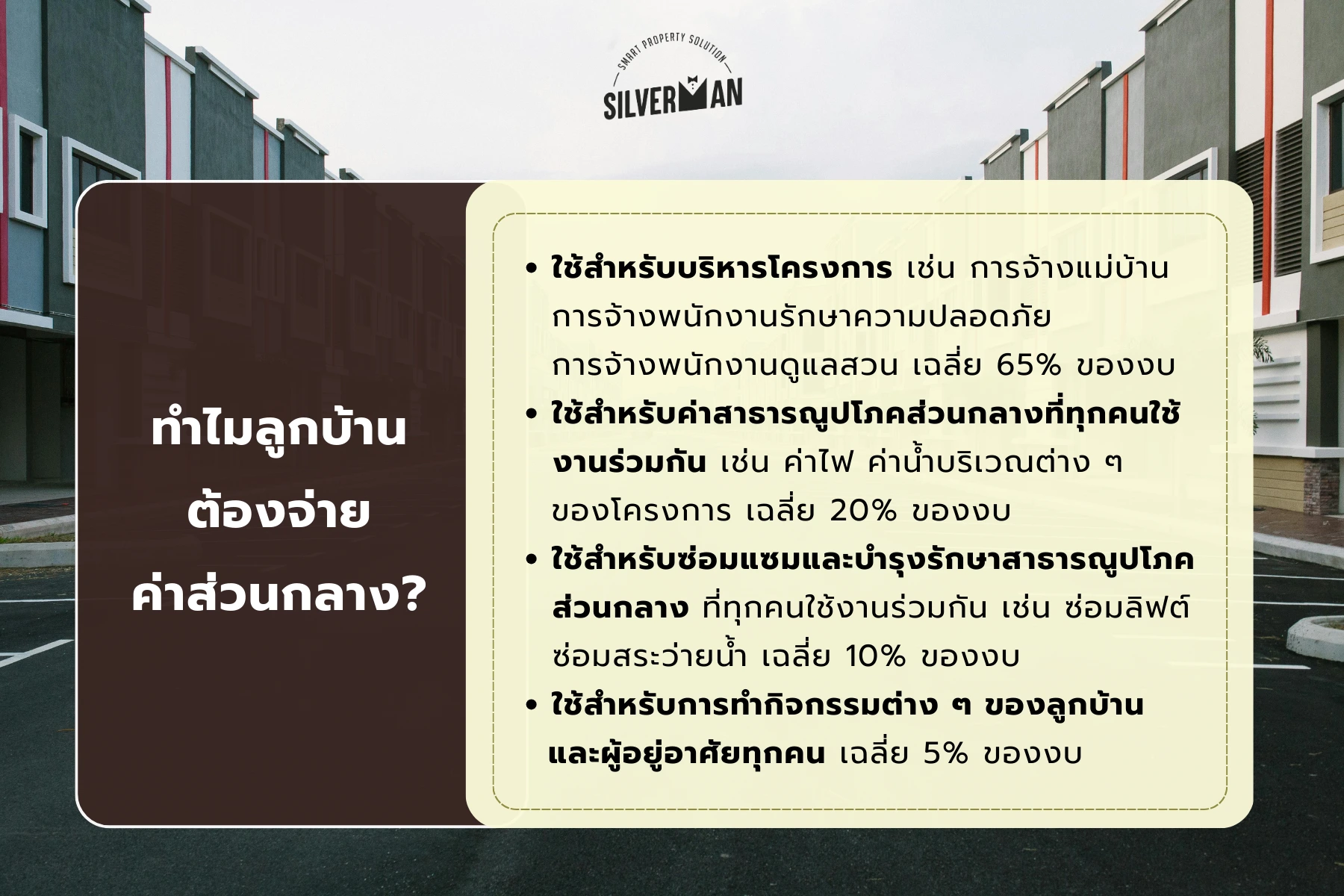 Why do residents need to pay common area fees to the juristic person, whether in a housing estate or a condominium? This may be a question many residents or co-owners have. Let's look at the reasons behind it, and what the committee actually uses this money for.
- Used for project management, such as hiring security staff, cleaning staff, and gardening staff — averaging 65% of the budget.
- Used for shared common utilities that everyone uses, such as electricity and water in various areas of the project — averaging 20% of the budget.
- Used for repairing and maintaining shared common facilities, such as elevator repairs, swimming pool repairs, garden upkeep, and playground improvements — averaging 10% of the budget.
- Used for organizing activities for residents, such as the annual meeting and New Year celebrations — averaging 5% of the budget.
In summary, the reason residents must pay common area fees is so that the juristic person can manage the project and provide convenience and comfort for all residents.
What Factors Determine How Common Area Fees Are Calculated?
 For anyone wondering what goes into calculating common area fees — since even projects in similar locations can have noticeably different fees — here's the answer:
- The number of houses or units in the project. The more houses or units available, and the more residents there are, the more people there are to split the common area fees among, which brings the cost per person down.
- The size of the property. House lots are measured in square wah, while condo unit space is measured in square meters.
- The project's amenities. The more amenities there are, or the higher their quality, the higher the common area fees are naturally likely to be.
- The materials, design, and decor of the project. The better and more expensive the materials used, the higher the common area fees residents must pay to match that quality.
- The quality of management. Project owners typically select a juristic person to help manage the property. Choosing a leading management company with higher costs usually means higher common area fees as well.
How Are Common Area Fees Calculated?
 Now for the question many people want answered: how are common area fees calculated? To help you get a basic idea of what to budget for — whether for a condo or a housing estate — here's a simple method, along with some additional information you can apply for yourself.
1. When Are Condominium Common Area Fees Paid?
There's no fixed rule for exactly when condominium common area fees must be paid, but juristic persons typically collect them in advance, in cycles such as every 3, 6, or 12 months.
2. Example Calculation of Common Area Fees
Calculating common area fees isn't complicated. The basic formula is: living area x price per unit area. For example:
Mr. A lives in a detached house with an area of 50 square wah, and the project charges a common area fee of 30 baht per square wah. Applying the formula:
50 x 30 = 1,500 baht / month
Mr. B lives in a 1-bedroom condo unit with an area of 35 square meters, and the project charges a common area fee of 35 baht per square meter. Applying the formula:
35 x 35 = 1,225 baht / month
3. How Late Payment Penalties Are Calculated
As explained earlier, the late payment penalty is calculated by taking the monthly common area fee x the number of months overdue x the interest rate set by the juristic person, which gives you the interest amount. This is then added to the outstanding balance — residents must pay both the outstanding principal and the interest together. For example:
Mr. A owes 1,200 baht per month in condominium common area fees for 2 months, at a late payment interest rate of 10% for delays of up to 6 months. Applying the formula:
Interest owed: 1,200 x 2 x 10% = 240 baht
Outstanding common area fees plus interest: 2,400 + 240 = 2,640 baht
What Happens If You Don't Pay Common Area Fees?
 Looking at the bigger picture, if residents don't pay their common area fees, the juristic person won't have the funds to manage various aspects of the project, such as paying security staff, cleaning staff, and maintaining common area equipment. As a result, the project's condition will deteriorate quickly, becoming less pleasant to live in and posing risks to all residents. On an individual level, any co-owner who refuses to pay will face the legal penalties described above.
How to Resolve the Issue When Residents Don't Pay Common Area Fees
Initially, if a resident doesn't pay their common area fees, the juristic person's committee should follow up, ask questions, send reminders, and try to understand the reason for non-payment. If, after assessment, the committee finds that the fees are set too high, they can be adjusted downward as appropriate, or reduced for a certain period, provided this is approved by a resolution at a meeting. However, if the resident still refuses to pay and continues to delay, the juristic person's committee also has the right to take legal action. Alternatively, you can use Silverman's debt collection and follow-up service for common area fees.
 Common area fees are something every resident or co-owner is responsible for, and must be paid in accordance with the conditions set by the juristic person, in order to fund the management of various aspects of the project. However, if a project's committee is facing issues with collecting common area fees and residents refuse to pay, the process typically involves discussion, follow-up, and warnings — and, ultimately, may require legal action. This is exactly where Silverman is happy to help every juristic person, whether for a housing estate or a condominium, with an automated debt-tracking system and AI-powered payment reminders developed to replace traditional collection methods — convenient and highly cost-effective for your business. You can also choose our service for tracking, following up on, and pursuing legal action for "overdue common area fees" from co-owners/residents, both Thai and foreign, quickly and effectively. Say goodbye to the hassle of payment reminders. Silverman also offers many other services ready to support juristic persons at every project, including accounting software for juristic persons, for both condominiums and housing estates, featuring automatic slip verification powered by AI technology along with automatic integration between income-expense accounting and the general ledger (GL); property management software that makes it easy to connect with residents and helps manage resident security through a variety of functions; as well as our juristic person formation and project handover service, and more. If you're interested in our services, be sure to contact the Silverman team today.


Download Application


Contact us for more information


Add-On services
- E-meeting (e-AGM)
- Visitor Control Management and Parking lot control
- Security Systems and License Plate Recognition (LPR)
- AI Facial Recognition & Access Control Management System
- Automatic Debt Collection System and Legal Services
- Incorporation services and project assignments
- Accounting As A Service
- Audit As A Service
Connect with us
- Management & Accounting program
- E-meeting (e-AGM) and E-vote
-



Member of


Certified by


Awarded by

Accounting and Finance
Juristic Person Management
Property Management Services
Accounting Software for Juristic
Management Software for Juristic
Read More