Housing Estates and Land and Building Tax: How Much Do You Have to Pay, How Is It Calculated, and What Homeowners Need to Know
Housing Estates and Land and Building Tax: How Much Do You Have to Pay, How Is It Calculated, and What Homeowners Need to Know
If you asked one hundred homeowners in a housing estate, "Do you have to pay land and building tax on your home?" you would probably receive three common answers: "I don't know," "I'm not sure," or "I don't think I have to."
The truth is that it depends on how the property is used. Some homeowners do not have to pay anything at all, some are required to pay every year, and others may be paying a higher tax rate without realizing it. Following the implementation of the Third Amendment to the Land Allocation Act, the responsibilities of both homeowners and property management organizations have become much clearer.
This article explains the different scenarios, who is responsible for paying the tax, how much is payable, what tax exemptions may apply, and the correct payment procedures.
What Is Land and Building Tax, and Why Does It Matter for Housing Estates?
Previously, Thailand imposed two separate property-related taxes: the House and Land Tax and the Local Development Tax. These overlapping taxes were often difficult to calculate, so the government replaced them with the Land and Building Tax Act B.E. 2562 (2019), which came into effect in 2020.
The new law represented a major reform of Thailand's property tax system. Instead of calculating tax based on rental income, the tax is now determined by the property's assessed value and its intended use.
Land and building tax is therefore calculated based on two factors:
- The government's assessed value of the property
- The property's usage category
It is not based on the owner's income or the property's purchase price.
Unlike income tax, this tax is not collected by Thailand's Revenue Department. Instead, it is administered by the relevant local administrative organization (LAO), such as a municipality, subdistrict administrative organization (SAO), or district office, depending on where the property is located.
As a result, homeowners in housing estates receive their land and building tax notices from their local authority rather than from the central government.
Do Homeowners in Housing Estates Have to Pay Land and Building Tax?
The short answer is yes, but whether you actually have to pay—and how much—depends on your individual circumstances.
Primary Residence
Under the law, a primary residence is a home where:
- The owner is listed in the household registration (Tabien Baan), and
- The owner's name also appears on the property's title deed.
If both conditions are met, the property qualifies as the owner's primary residence.
The benefit is significant: properties with an assessed value of up to THB 50 million are exempt from land and building tax.
In simple terms, if the combined assessed value of your house and land does not exceed THB 50 million, you pay no land and building tax at all.
Since the assessed value of most homes in housing estates is well below THB 50 million, homeowners who have properly registered their primary residence generally do not have to pay this tax.
Second Homes or Properties That Are Not Owner-Occupied
If you own a house but have not transferred your household registration to that address, or if you own multiple homes and have registered your residence at only one of them, the remaining properties are classified as secondary residences.
Secondary residences are not eligible for the primary residence tax exemption, meaning land and building tax is payable starting from the first baht of assessed value.
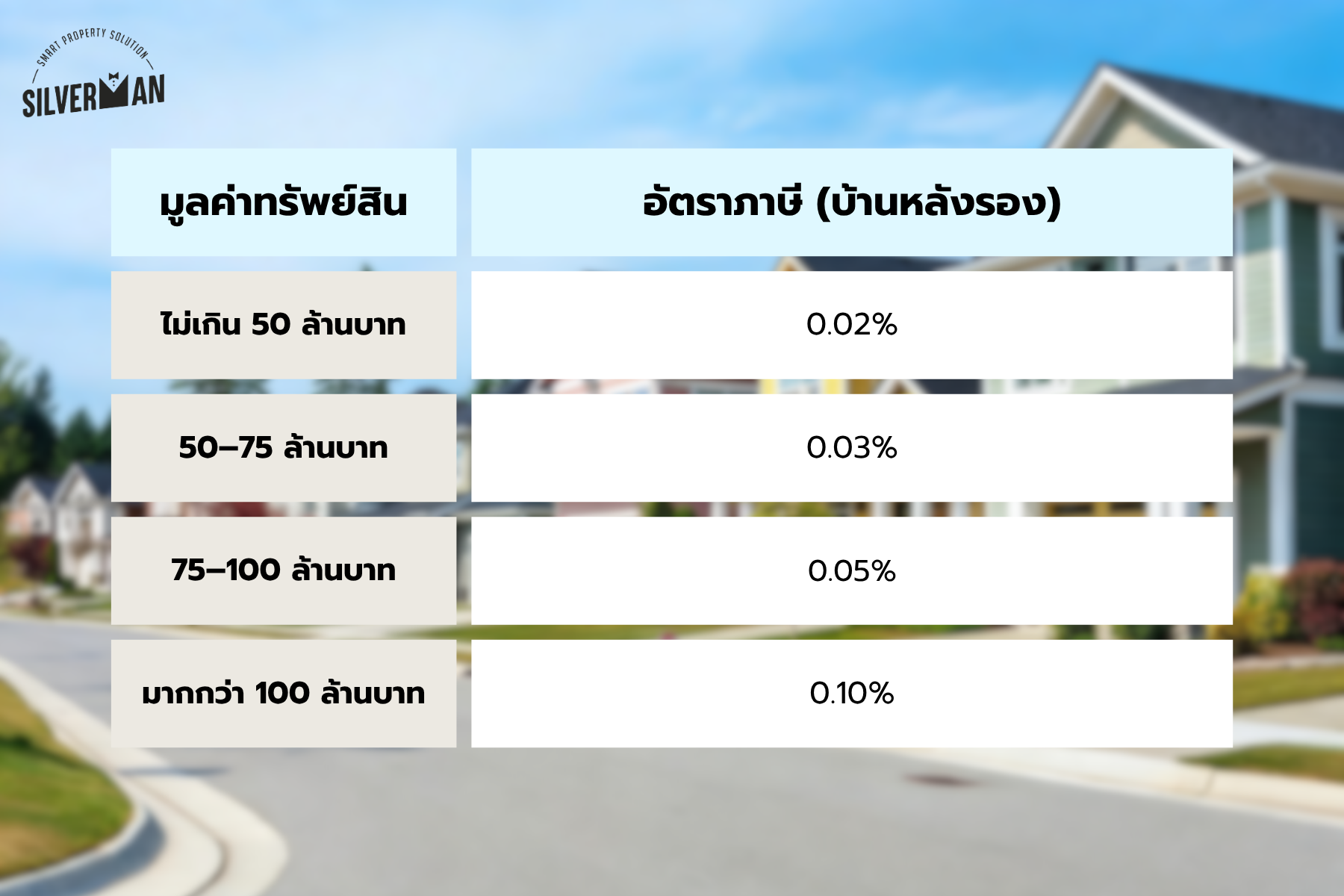
Example: A secondary residence with an assessed value of THB 4,500,000 would incur an annual land and building tax of THB 900. While the amount is relatively small, it must be paid every year.
Rental Properties
This is an area where many homeowners are often mistaken. A property that is rented out to tenants, whether on a monthly or yearly basis, is classified under commercial use rather than residential use under Thai law. As a result, it is subject to a significantly higher tax rate.
In general, the tax rate starts at 0.3%, which is substantially higher than the rate applied to a secondary residence that is not rented out.
Vacant or Unused Properties
Homes or land that are left vacant and unused are subject to the highest land and building tax rates. The tax begins at 0.3%, and if the property remains unused, the rate increases by 0.3% every three years, up to a maximum rate of 3%.
The taxation of vacant land differs significantly from other property categories because the law is intended to encourage productive use of land rather than allowing it to remain idle. In other words, the longer a property is left unused, the higher the tax burden becomes.
Can You Reduce Your Land and Building Tax?

Yes. In fact, many homeowners are able to reduce their land and building tax without realizing it. Simply taking care of a few basic administrative matters can significantly lower the amount of tax you owe.
1. Register Your Primary Residence
This is the simplest and most effective way to reduce your tax liability.
If you purchase a home but do not register it as your official residence in the household registration (Tabien Baan), the property is treated as a secondary residence and becomes subject to land and building tax immediately. Once you register your household at the property, however, it qualifies as your primary residence. If its assessed value does not exceed THB 50 million, you are fully exempt from the tax.
This exemption applies to only one property, but if it is the home where you actually live, there is little reason not to update your household registration accordingly.
2. Put Vacant Land to Productive Use
Vacant land and unused properties are subject to the highest land and building tax rates.
By putting the land to productive use—for example, growing vegetables, creating a small garden, or engaging in agricultural activities—you may be able to change its classification from vacant land to agricultural land.
Agricultural land is taxed starting at 0.01%, compared with 0.3% for vacant land—a difference of 30 times.
3. Verify the Property Classification Recorded by Your Local Authority
Many homeowners end up paying more tax than necessary because their property has been incorrectly classified by the local administrative organization (LAO).
For example, a residential property may mistakenly be recorded as a commercial property. Whenever you receive your annual tax assessment notice, you should carefully review the property's classification before making payment. If you discover an error, you may submit a request for correction within the deadline specified in the notice.
How to Calculate Land and Building Tax Yourself
Calculating land and building tax is much simpler than many people expect. There is only one basic formula:
Tax Formula
Assessed Property Value × Tax Rate = Annual Land and Building Tax
The assessed value used for tax purposes is the value determined by the Treasury Department, not the property's actual purchase price or current market value. In most cases, the official assessed value is lower than the market price.
Example Calculations
Example 1
Mr. Kong owns a detached house in a housing estate. The combined assessed value of the land and house is THB 4,500,000, and he is registered at this address in the household registration.
Since the property's assessed value is well below the THB 50 million exemption threshold for a primary residence, the entire property is exempt.
Land and building tax payable: THB 0
Example 2
Ms. Min owns another house in a housing estate with a combined assessed value of THB 4,500,000, but she has not transferred her household registration to this address because she officially resides elsewhere.
Since this property is classified as a secondary residence, it is not eligible for the primary residence exemption.
THB 4,500,000 × 0.02% = THB 900 per year
These examples show that the most important factor is your household registration, not the value of your home. If you have purchased a home but have not yet registered it as your primary residence, it may be worthwhile to consider doing so.
Paying Land and Building Tax: What Do Homeowners Need to Do?
The good news is that homeowners do not have to file a tax return themselves as they do for personal income tax.
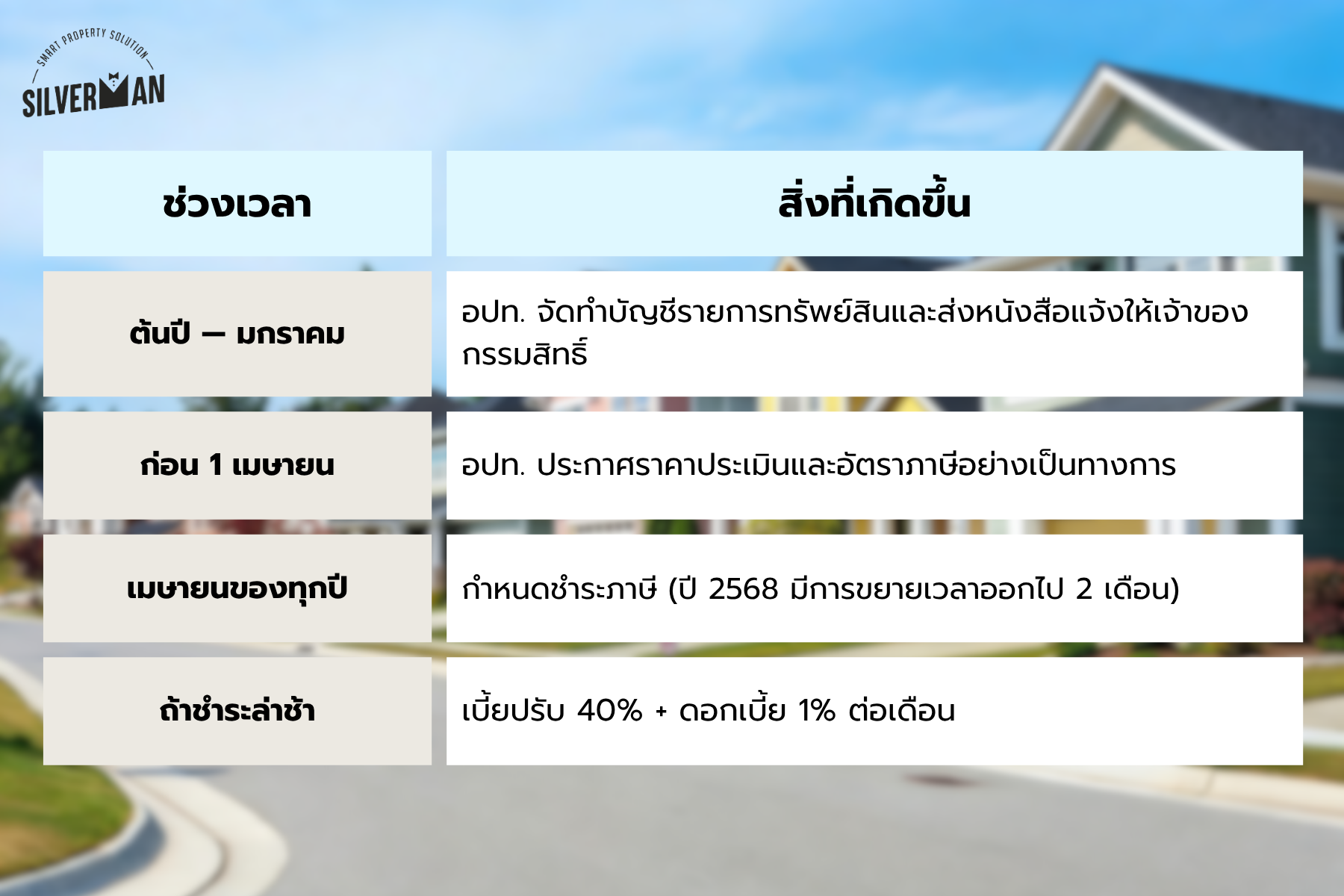
Instead, the entire land and building tax assessment process is handled by the relevant local administrative organization (LAO). The process works as follows:
Payment Methods
Homeowners can pay their land and building tax through several channels, including:
- The office of the relevant local administrative organization (LAO)
- Participating banks
- Online payment systems provided by certain local authorities
The available payment methods may vary depending on the local authority responsible for the property.
If Your Tax Bill Is High
If your land and building tax is relatively high, you may be eligible to pay it in up to three installments by submitting a request to your local administrative organization before the payment deadline. Eligibility requirements and minimum tax amounts may vary depending on the local authority.
Important Reminder
When you receive your annual tax assessment notice, always verify that the information is accurate, including both the property's assessed value and its usage classification. If you find any errors, you may submit a request for correction within the deadline specified in the assessment notice.
Paying your land and building tax on time will help you avoid penalties and additional charges.
Who Pays Land and Building Tax on Common Areas in a Housing Estate?

Who Pays Land and Building Tax on Common Areas in a Housing Estate?
What about the roads within a housing estate, landscaped gardens, swimming pools, clubhouses, or the property management office? Is anyone responsible for paying land and building tax on these common areas?
The answer is yes. The responsibility falls on the housing estate juristic person (property management organization)—not the individual homeowners. This is because the juristic person owns or is responsible for managing the common property following the transfer of the development from the developer. These assets are typically administered through a dedicated property management system.
However, where does the money come from?
In practice, the tax is paid from the common area maintenance fund, which is financed by the monthly or annual common fees paid by homeowners. In other words, a portion of the common fees collected each year is used to cover the land and building tax on the estate's shared facilities.
Accounting Treatment of Land and Building Tax for Property Management Organizations
For housing estate juristic persons, land and building tax on common property should be recorded as an operating expense, typically under utilities or administrative expenses. It should be clearly separated from expenses relating to individual homeowners.
A common issue in many housing estates is the lack of proper accounting classifications or a system for tracking how much tax is payable on each common property each year. As a result, when annual audits are conducted, management teams often struggle to locate historical records or supporting documentation.
A well-designed property management accounting system should support the recording of land and building tax expenses while integrating them automatically into the property's income and expense records. Property management organizations that still rely on Excel spreadsheets or paper-based records may benefit from adopting an integrated accounting and tax management solution. For communities without an in-house accounting team, outsourced accounting services such as those offered by Silverman can also provide an effective alternative.
Conclusion
For most homeowners whose property is their primary residence, whose household registration is correctly recorded at the property, and whose home's assessed value does not exceed THB 50 million, no land and building tax is payable.
However, homeowners who own multiple properties, have not updated their household registration, or rent out their property should carefully review their tax status before each annual payment period.
For housing estate juristic persons, land and building tax on common areas is an unavoidable operating expense that must be accurately recorded every year.
Silverman is designed to help property management organizations handle these responsibilities transparently from the outset. Its integrated platform provides real-time accounting with complete audit trails, together with a resident mobile application that enables homeowners to monitor project information, pay common fees, and submit maintenance requests anytime, anywhere.
Communities that adopt a centralized property management system are generally better equipped to demonstrate transparency and accountability, because the information is already available within the system whenever questions arise.
To learn more, visit silverman.app or call +66 8-1442-6888.


Download Application


Contact us for more information


Add-On services
- E-meeting (e-AGM)
- Visitor Control Management and Parking lot control
- Security Systems and License Plate Recognition (LPR)
- AI Facial Recognition & Access Control Management System
- Automatic Debt Collection System and Legal Services
- Incorporation services and project assignments
- Accounting As A Service
- Audit As A Service
Connect with us
- Management & Accounting program
- E-meeting (e-AGM) and E-vote
-



Member of


Certified by


Awarded by

Accounting and Finance
Juristic Person Management
Property Management Services
Accounting Software for Juristic
Management Software for Juristic
Read More